Thailand Pet Care Market
Key Shifts in Thailand’s Pet Market 2026: From Humanization to Premium Food Choices
Thailand’s pet care market is evolving as pet owners embrace more emotionally driven relationships and increasingly health-conscious choices. Pets are no longer seen as just animals. This emotional lens is now shaping every aspect of pet ownership, from feeding routines to product expectations.
Based on the latest findings from the TGM Pet Care Insights 2026 – Pet Nutrition and Product Purchases in Thailand (https://tgmresearch.com/pet-nutrition-product-insights/thailand.html) and Pet Health & Veterinary (https://tgmresearch.com/pet-health-insights/thailand.html), this article explores key consumer shifts that are redefining the market, and what they mean for brands looking to stay ahead in a more humanized, health-oriented landscape.
Key Local Insights from TGM’s Research
- Cats and dogs achieve near equal representation in Thai multi-pet households
- Most owners see their pets as family, not just animals.
- Quality tops all considerations when Thai pet owners choose food.
- Thailand is a strong market for dog food brand loyalty and word-of-mouth advocacy.
The Thai Multi-Pet Balance: Cats and Dogs Achieve Near Equal Representation
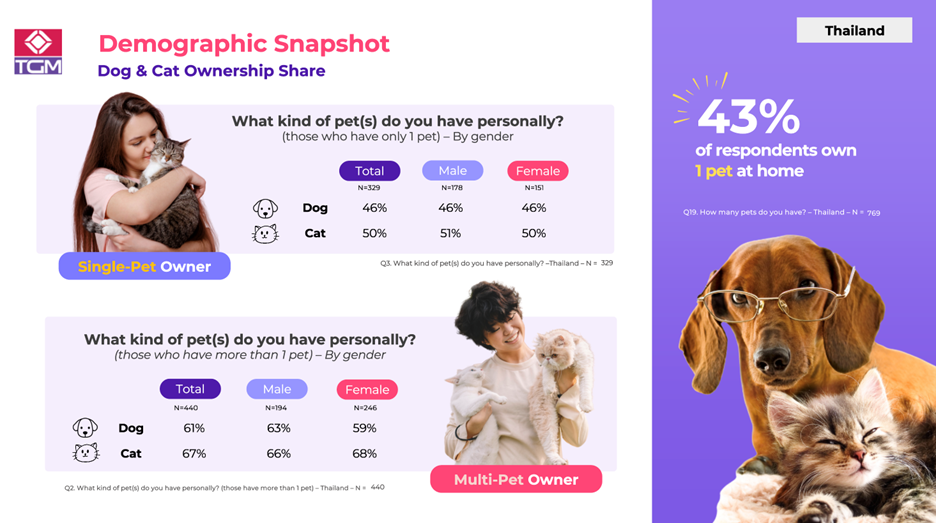
Dogs and cats remain the most popular companions in Thailand, but within multi-pet households, cats hold a slight lead. While the gap isn’t drastic, it hints shifting dynamics in pet preferences, potentially driven by lifestyle factors like smaller living spaces or the appeal of lower-maintenance companions. For brands, it could be a good time to look again at how much attention is given to cats.
Pets like fish, parrots, and small mammals, though less common, are carving out space in Thai homes, creating new demand for species-specific care and accessories often missing from mainstream shelves.
Thai Owners Are Emotionally Humanizing Pet Relationships
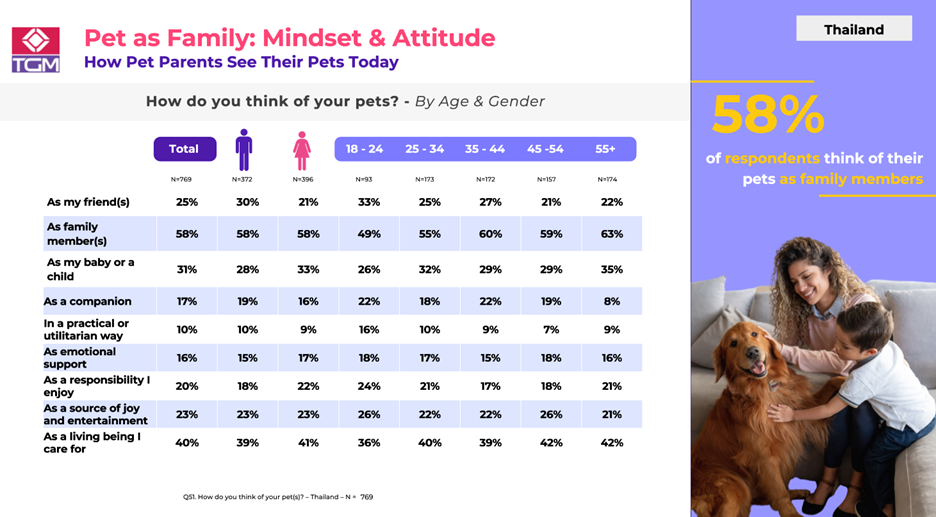
In Thailand, pet ownership goes far beyond responsibility, it’s emotional, intimate, and deeply human. Many owners don’t just care for their pets; they define their place in the household in profoundly personal ways. 43% of Thai own 1 pet at home, and 58% of owners think of their pet as family members. Others describe them as emotional supporters, even their own children.
This emotional depth influences everything from how pets are fed and groomed to the kinds of services and experiences owners seek. Pet products are chosen with the same thought and care as those for loved ones. For brands, this means offering solutions that speak to the heart, products and services that reflect love, trust, and emotional connection, not just utility.
Thai Pet Owners Prioritize Quality Over Cost When Choosing Pet Food
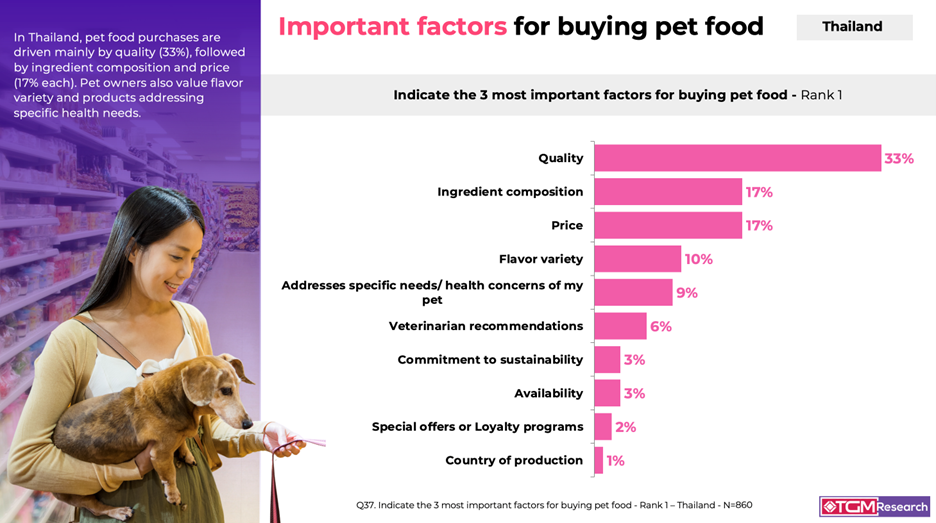
With many owners seeing pets as family, or even as their own children, quality naturally takes the top spot when choosing what goes into their bowl. Thai owners look for high-quality, trusted ingredients and products that support their pets’ specific health needs, often paying close attention to composition, price and flavor variety.
Things like flavor or promotions still matter, but they come after what truly matters: making sure pets are healthy and well cared for. This mindset is driving demand for better, more health-focused pet food. For brands, it’s a clear signal to focus on transparency, nutrition, and trust, just like it would be for human food.
Pet Food Recommendation Trends in APAC and Thailand
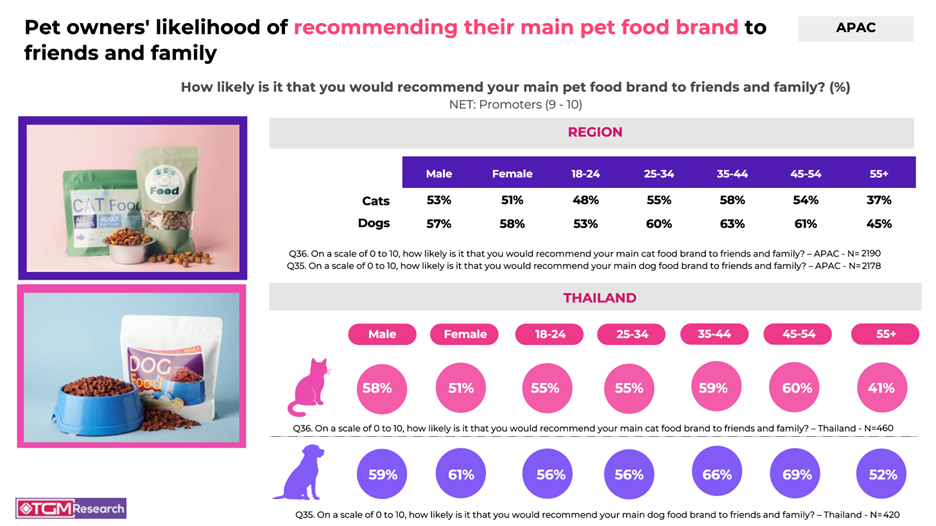
Pet owners across the APAC region show a moderate willingness to recommend their main pet food brands, with dog owners generally more enthusiastic than cat owners. In Thailand, recommendation levels are slightly higher overall. For cat food, owners report a strong likelihood to recommend their brand, with the highest endorsement coming from the 45–54 age group (60%). Dog food brands in Thailand perform even better, achieving recommendation rates of 59–69% across most demographic groups. These results highlight Thailand as a particularly strong market for dog food brand loyalty and word-of-mouth advocacy.
While mainstream preferences still favor affordability and convenience, a growing share of owners are seeking pet food with specific health benefits, transparent ingredients, or vet-endorsed claims. For premium or specialized brands, this means the market is evolving. The key lies in precision: focus on product integrity, educate health outcomes, and distribute through credible channels like veterinary clinics and specialized e-commerce platforms.
To explore more insights on pet care behaviors, check out the full TGM Pet Care Survey Thailand 2026.
Conclusion
Thailand’s pet market is being reshaped by three powerful forces: emotional humanization of pets, rising demand for quality-driven nutrition, and continued loyalty to trusted, well-established brands.
To stay relevant, brands must align with what today’s owners truly care about. That means delivering trusted, health-forward solutions that reflect the same standards people expect for themselves.
Curious how APAC pet owners are setting up trends with every treat they buy and every service they book? Our full series of TGM Global Pet Care Insights 2026 reports is rolling out, covering Pet Nutrition & Product Purchases, Pet Health & Vet Care, Pet Ownership & Lifestyle, Pet Service, Accessories & Grooming, and Pet Tech & Innovation.
Get Access to the Full Euromonitor Report

2022
Thailand’s pet industry in currently the second largest in Asia next to China valuing at 700 – 800 million USD (2019).
Generally, pet dogs and cats are the most popular pets in Thailand at 47% and 42% respectively, followed by Fish (11%), Bird (4%), Rabbit (3%), and Rodents (3%). There are approximately 8.9 million dogs and 3.3 million pet cats in the Thai households (Hypercube Insights, 2020)
According to the Thai Pet Product Industries Association (TPIA), the Thai pet market has been growing at the average of 10% annually since 2011. Between 2017 – 2019, the pet market in Thailand is valued at 29.3 billion , 32.2 billion, and 36 billion Thai Baht respectively.
Pet Food holds the largest market share at 45%, followed by pet healthcare services at 33% (this includes hospitals, clinics, pet care centers, grooming services, etc.), and the rest are pet apparel, accessories, and toys.

In 2019, overall value of Thai pet market was at 35,453 million Thai Baht (US$1.06 billion), with pet food at 45% (15,954 million Thai Baht; US$475 million), pet services at 32% (11,345 million Thai Baht; US$337.8 million), and pet supplies at 23% (8,154 million Thai Baht; US$242.8 million)(Pet Expo Thailand, 2020).
Pet Humanization Phenomenon
For the past decade, Thailand has been experiencing the ‘pet humanization’ phenomenon, where economy continues to grow and as birth rate starts to decline. Many households now consist of singles, childless couples, and empty nesters. This leads to a higher pet acquisition rate, where people are no longer ‘Pet Owners’ but are now ‘Pet Parents’. These pet parents are willing to spend more on high quality food, clothes, accessories, and various pet services such as pet day care centers, pet spas, pet parks, etc. With the rising Middle Class, the demand for quality pet products is steadily growing with no sign of decline in the near future.
Pet Food Market in Thailand
With the highest market share in the market and despite the COVID-19 pandemic, pet food sector had registered an average of 10% growth from January to October in 2020. The value of pet food export in Thailand during Q1 2020 was at 16 billion Thai Baht, which increased at 10% rate y-o-y. The value of pet food exports to markets such as India, USA, ASEAN countries and Australia was 620 million, 3.4 billion, 3.6 billion, and 733 million Thai Baht respectively. Dog and cat food accounts for 81% of the export with 90% for the OEM market.
Thailand is ranked 4th largest pet food exporter as reported by World’s Top Exports with the total of 15.1 billion USD as of 2019. The other top fives include Germany (1.8 billion USD), USA (1.6 billion USD), France (1.5 billion USD), and Netherlands (1.2 billion USD).
In 2019, Thailand was also ranked 2nd largest pet food exporter to Europe after China with value at 215 million Euro. See below table.

Pet Food Market Structure in Thailand
As pet food market in Thailand continued to performed well in the past years, more and more companies are trying to expand into the market which leads to intense competition. There are now more than 30 brands in the market competing for their share.
Main players in the Thai market are leading Thai food producers what expanded their businesses into the pet food sector, this includes CP (Charoen Pokphand Group), Betagro (DOGnjoy), Asian Group (Monchou), Thai Union Group, etc. and global companies such as Mars Inc. and Nestle Purina, with production hubs in Thailand to serve the local and export demand. Imported pet food only have about 5% market share, mostly from USA, France, South Korea, Australia, and Austria respectively (Customs Department, 2020)

Pet Food Trends in Thailand
With pet humanization on the rise, many pet parents are willing to spend on high quality products, as such, premium pet food is in high demand. Pet parents are seeking products that are made from natural raw ingredients with no artificial substances like flavors and colors. With this trend, many brands are offering various food recipes to the Thai pet consumers. Pet owners in Thailand are looking for products that are:
- Natural, organic, and grain-free
- Vegan or plant-based food
- Fish-based food
- Specific food for different breeds, weight, ages, and activities
- Innovative products (E.g. prescription food, supplement, functional food, food for pets with various health issues, etc.)
There is also an increasing demand in pet health products, pet treats/snacks, freeze-dried meat for dogs, fruit and vegetables-based food, biscuits, dental/oral care sticks, etc. as well
Distribution Channels for Pet Products in Thailand
Main distribution channels for pet products in Thailand are mainly special trade channels (i.e. pet shops, clinics, hospitals, and pet farms/breeders) and modern stores (i.e. supermarkets, hyper markets, and convenient stores). Both channels make up approximately 90% of the market. Special trade channels offer a larger variety of pet products from economy options to premium options, while the supermarkets offer a more limited selection due to smaller spaces. Below, you can see that 40% is made up of modern trade supermarkets and convenience stores, while the 60% made up of pet shops and specialty stores like pet clinics (Royal Canin Thailand, 2019)

Additionally, e-commerce are booming in Thailand especially during the COVID-19 pandemic. Consumers are turning to online shopping due to the convenience of delivery services, time-saving, and more wide-ranging offers. E-commerce platforms in Thailand includes Lazada, Shopee, JD Central, and other supermarkets with online stores.