Philippines Pet Market

Three Key Trends Reshaping the Philippines Pet Care Market 2026
The pet care landscape in the Philippines is transforming as owners place greater importance on pet health, lifestyle compatibility, and convenience. As companion animals take on a more central role in households, Filipino pet owners are reshaping the market through their care preferences and purchase habits.
Based on insights from the TGM Pet Care Insights 2026 – Nutrition and Products Purchases in the Philippines (https://tgmresearch.com/pet-nutrition-product-insights/philippines.html) and Pet Health and Veterinary Care (https://tgmresearch.com/pet-health-insights/philippines.html) and other trending topics, this article highlights key trends driving today’s market and signals new opportunities for industry players to innovate and adapt to the evolving needs of pet parents.
Key Local Insights from TGM’s Research
- In the Philippines, veterinary care is the most popular pet service, followed by professional grooming.
- Dogs and cats are the most common pets in the Philippines.
- Independent pet stores or small pet chain are the leading channel for purchasing pet food, with 43% of Filipino owners preferring them.
Filipino Pet Owners Mostly Spend on Vets and Grooming
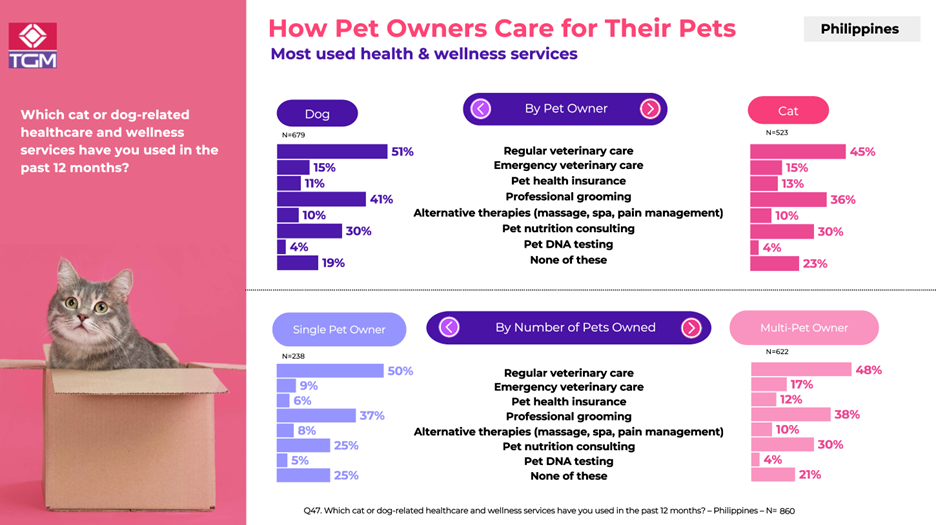
In an era where pets are increasingly seen as family members, Filipino pet owners are turning to a variety of care services. The high use of veterinary care and professional grooming services shows that owners genuinely prioritize their pets’ health and hygiene and are ready to spend quality care. A small but growing number of owners are also exploring holistic care options, such as massage and spa services. Meanwhile, specialized offerings like pet nutrition consulting or untapped potential for brands willing to invest in true health value and trust-building.
Dogs and Cats Remain the Top Household Pets in the Philippines
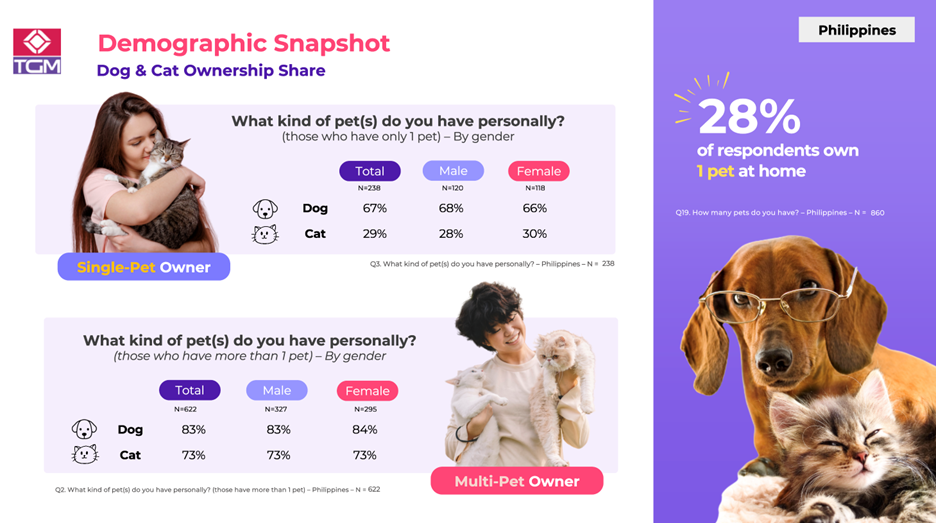
New insights from TGM Research reveal that dogs and cats are by far the most owned pets among Filipino households, often coexisting under the same roof. Less common pets include fish, rabbits, parrots, and small mammals like hamsters and mice, pointing to niche markets for specialized care and accessories.
As pet households grow more diverse, brands have an opportunity to create species-inclusive products and services tailored to multi-pet families, from shared feeding systems to adaptable wellness solutions.
Independent Pet Stores Emerge as the Leading Pet Food Retail Channel in the Philippines
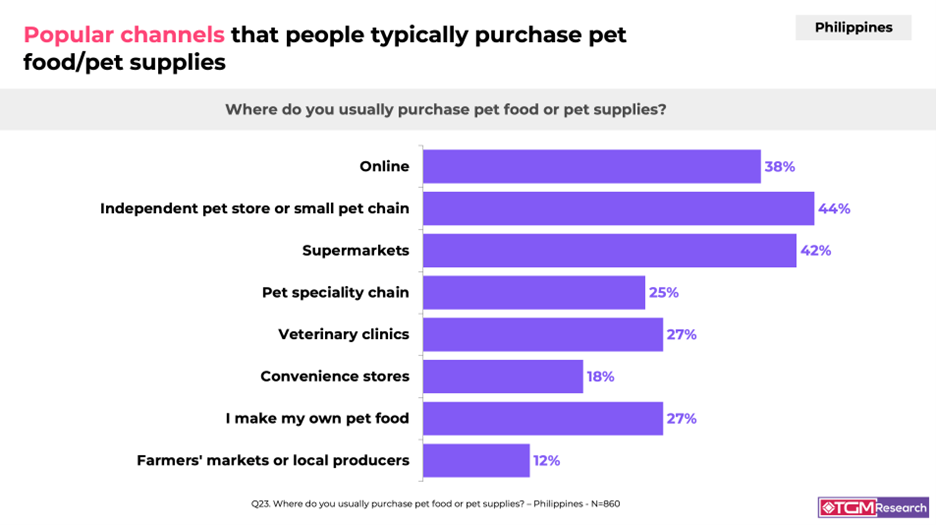
Independent pet stores and small pet chains now lead pet food purchasing in the Philippines (44%), driven by owners seeking tailored advice and niche product choices. To stay ahead, these stores can leverage curated assortments and unique in-store experiences that big retailers cannot match.
Supermarkets follow closely behind at 42%, appealing to shoppers through convenience and integration into weekly grocery trips. This makes strong shelf visibility, strategic placement, and in-store promotions essential for mainstream pet food brands.
Meanwhile, the appetite for digital convenience is growing, with a substantial portion of pet owners now buying food online. Brands and retailers in the Philippines with optimized e-commerce platforms, seamless delivery logistics, and personalized digital experiences will have a strong chance of attracting today’s tech-savvy pet owners.
Conclusion
The Philippines’ pet care market is evolving around three key drivers: growing investment in health and grooming services, increasingly diverse pet ownership, and a shift toward convenient retail channels like supermarkets and e-commerce.
To stay competitive, brands must blend trust, accessibility, and innovation, meeting modern pet owners where they are and anticipating where they’re headed.
Curious how APAC pet owners are setting up trends with every treat they buy and every service they book? Our full series of TGM Global Pet Care Insights 2026 reports is rolling out, covering Pet Nutrition & Product Purchases, Pet Health & Vet Care, Pet Ownership & Lifestyle, Pet Service, Accessories & Grooming, and Pet Tech & Innovation.
Get the Full Euromonitor Report Here

2022
The Philippines have the highest rate of pet ownership among the Southeast Asian countries at 83%, led by dogs at 67%, cats at 43%, fish at 13%, and birds at 10% (Rakuten Insights, 2021)
As of 2017, consumption of pet food in the Philippines was at an all-time high, due to a surge in pet owners with more willingness to spend more on their pets’ health. It is estimated that there are about 13.6 million dogs and 1.8 million cats in 2016. As such, the pet food sales were expected to grow accordingly (Euromonitor, 2016)
Revenue in the Pet Food segment amounted to US$72 million in 2021, with expectation to grow annually by 7.13% (CAGR 2021 – 2026). Volume in pet food are expected to amount to 52.4 million kilograms by 2026, it is expected to have a growth rate of 9.9% in 2022 (Statista, 2021)
Pet Food On the Rise
Pet owners in the Philippines prefer to imported pet food, especially those made in the US or European Union countries.
According to the US Department of Agriculture (USDA), the US has been the largest exporter of pet food to the Philippines since 2012, with a 61% market share. Still, Filipino pet owners are sensitive to price and prefer more economic options.
According to Purina Philippines, which targets more premium and super-premium pet food buyers, stated that the market for economy products is larger and dominated by kibble brands selling at US$2.00 or less per kilogram. However, Purina believes that more Filipino pet owners are increasingly willing to spend more on premium food that meets their pets’ nutritional requirements.
According to MetroPet’s survey, brands that dominated the market are: Pedigree, Royal Canin, Alpo, Holistic, Beef Pro, Vitality (Australia) and Monge (Italy). All are considered premium. Nevertheless, pet shops also sell less premium options such as Beef Pro (US$1.82/Kg) and Special Dog (US$1.85/Kg) as well to tap the mass market.
Mars Philippines is also in a unique position in market as they offer a wide range of dry and wet pet food at different price points to accommodate different customer groups. They are expected to be the market leader for the foreseeable future (Euromonitor, 2016)

Dry Pet Food Leader in Dog Market
It is said that the Philippines is the “dog capital of East Asia” as survey said there is one dog for every eight people there.
According to the Philippines Canine Club Inc., the local registry for purebred dogs, there were more than 21,000 members with more than 70,000 registered purebred dogs in 2016. According to it’s records, the most popular breeds in the Philippines are Shih Tzu, Chihuahua, and the Pomeranian. Furthermore, the pandemic year 2020 saw a 9.5% growth in newborn puppies registered with the PCCI at 93,320 (Philippine Canine Club, Inc., 2020)
Store owners stated that dry pet food are the most saleable dog food category for dog owners, wet pet food are purchased only as a supplement for dry food to whet a dog’s appetite, especially when sick.
Wet Pet Food Leader in Cat Market
Although dog ownership rate far outpace that of cat’s, it has been noted that cat owners are more likely to pamper their pets with more “human-grade” wet food which came in small cans and pouches. They are also willing to spend more on high-end dry cat food that promises more health benefit.
The leader of the cat food market in 2016 was Mars Philippines at 48% market share. Followed closely by many other international brands like Monge’s Special Cat, Cuties Catz, and Princess. Monge’s Special Cat is made specially for the Philippines market and continued to be a highly sought after product selling for US$13.67 for a 7-kg bag.
Distribution Channels for Pet Food in the Philippines
Supermarkets and groceries mostly stock up on popular brands, usually from Mars and Purina, along with their own private label with lower price tags. The rest of the market players distribute through pet shops, veterinary clinics and pet cafes, or they sell directly to established breeders.
Almost everyone now has an online store or sells via a big online shop operator such as Lazada and Shopee. A number of small local online shops also fight for market share by providing a more personal level of customer service.